 I'm sorry for slow trickle of posts lately--Bien manger Bien etre is going under construction! I decided that it's time for this blog to get a new look and a new attitude...over the next couple weeks I'll be changing the design and features, and tweaking the content. So go cook some end-of-summer meals and let me take care of the dishes around here, and I'll see you back in a few!
dimanche 12 septembre 2010
Clean Up!
I'm sorry for slow trickle of posts lately--Bien manger Bien etre is going under construction! I decided that it's time for this blog to get a new look and a new attitude...over the next couple weeks I'll be changing the design and features, and tweaking the content. So go cook some end-of-summer meals and let me take care of the dishes around here, and I'll see you back in a few!

vendredi 27 août 2010
Quinoa Salad with grapes, carrots, and feta

Quinoa, a grain-like plant originating from South America, is our most complete plant source of protein; it contains a high amount of protein as well as a balance of essential amino acids, and it is gluten-free. In addition to the nutrition value, cooked quinoa is a very light grain (as opposed to the density of cooked pasta or rice), so it weighs less heavily on the stomach, which is certainly nice in the summer.
It’s a perfect vegetarian food for a healthy plant-based protein, or for anyone who would like to diversify their protein sources.
Quinoa can be compared to couscous in texture and to rice in preparation (you can make it in a rice cooker); basically it can be used as a substitute in any dishes calling for rice, also including pilafs, salads, and breakfast foods.
For a light and refreshing salad, combine the following ingredients:
2 cups quinoa, cooked and cooled
½ cup red grapes, halved
½ cup carrots, sliced or diced
½ cup feta cheese, crumbled
a drizzle of olive oil
juice of half a lemon
salt, pepper
It’s a perfect vegetarian food for a healthy plant-based protein, or for anyone who would like to diversify their protein sources.
Quinoa can be compared to couscous in texture and to rice in preparation (you can make it in a rice cooker); basically it can be used as a substitute in any dishes calling for rice, also including pilafs, salads, and breakfast foods.
For a light and refreshing salad, combine the following ingredients:
2 cups quinoa, cooked and cooled
½ cup red grapes, halved
½ cup carrots, sliced or diced
½ cup feta cheese, crumbled
a drizzle of olive oil
juice of half a lemon
salt, pepper
lundi 23 août 2010
Fruit Pizza

A birthday party classic, and one of my favoritest summer desserts . . . look how pretty it is! For those who have never yet had the good fortune to partake of a fruit pizza slice--there is nothing pizza about this, it's actually a big sugar cookie with cream cheese and fruit topping.
For my U.S. readers, fruit pizza requires exactly 2 store bought items plus fruit.
1) one tube of sugar cookie dough. cut into slices, arrange in circular fashion on a cookie sheet, and roll out until you have one smooth sheet of cookie dough. Even out the edges of the circle with a knife. Bake the big cookie according to the package directions and let cool.
2) one container of cream cheese fruit dip. Spread evenly over the cooled cookie.
3) Wash and slice your fruits of choice and arrange prettily (or randomly) over the cookie base. Ta-da!
For my U.S. readers, fruit pizza requires exactly 2 store bought items plus fruit.
1) one tube of sugar cookie dough. cut into slices, arrange in circular fashion on a cookie sheet, and roll out until you have one smooth sheet of cookie dough. Even out the edges of the circle with a knife. Bake the big cookie according to the package directions and let cool.
2) one container of cream cheese fruit dip. Spread evenly over the cooled cookie.
3) Wash and slice your fruits of choice and arrange prettily (or randomly) over the cookie base. Ta-da!

If you don't have access to sugar cookie in a tube or cream cheese fruit dip, follow your favorite sugar cookie recipe to make the dough. Cream cheese fruit dip can be made as follows:
Cream Cheese Fruit Dip
1 (8 oz.) package cream cheese, room temperature
1 cup confectioner's sugar
1 teaspoon vanilla extract or lemon juice
Whip all ingrediants together until smooth.
mardi 17 août 2010
Bamia et Soupe aux Lentilles

Je remercie une fois encore Safi pour deux recettes de plus; il me gâte! Voilà une soupe aux lentilles et un plat syrien fait avec des gombos qui s'appelle Bamia.
Bamia
Une boîte de Bamia (500 g de Bamia : 2 personnes) (indispensable)
Sauce tomates (indispensable)
De l’ail (indispensable)
Oignon (indispensable)
Huile d’olive
Poivre
Harissa
On chauffe une petite quantité d’huile d’olive dans une casserole, on rajoute un oignon bien coupé (en très petits morceaux), on le cuit un peu et on rajoute la Bamia (déjà cuite) avec un tout petit peu d’huile d’olive dessus. On ne chauffe un peu, et pas besoin d’attendre que la Bamia soit chaude.
On met du sel dans la sauce tomate, du poivre, un peu de citron, du Harissa mais surtout des gousses (3) d’ail bien coupées (elles doivent être coupées pour faire sortir leur saveur dans le plat). On verse la sauce dans la casserole (où il y a l’oignon et la Bamia), on couvre la casserole ou on attend un bouillonnement de 2/3 minutes.
Le plat est servi avec du riz, ou on peut le manger seul avec du pain.
Soupe aux lentilles 
Lentilles rouges
Un oignon
Demi-citron
Beurre
Une baguette
Une tasse de lentilles rouges (la quantité varie, si on veut la soupe légère ou pas), normalement c’est une tasse de thé. On le met dans une casserole, on la remplie d’eau et on le rejette (pour nettoyer les lentilles, sinon le plat ne sera pas réussi), on remplit et rejette de l’eau plusieurs fois (ça peut atteindre jusqu’à 15 fois), on arrête quand l’eau qu’on met dans la casserole est très sereine.
On ajoute un oignon bien coupé (en très petits morceaux) et on remplit donc les trois quarts de la casserole avec de l’eau. On ajoute du sel à volonté, on ferme la casserole et on laisse bouillir jusqu’à ce que le mélange constitue un ensemble cohérent (quand il y a plus de lentilles), ça devrait prendre 30 minutes. Après on ajoute du citron (demi) et du beurre. Dans la soupe on peut tremper des morceaux de baguettes ou bien les jeter dans la soupe.

Lentilles rouges
Un oignon
Demi-citron
Beurre
Une baguette
Une tasse de lentilles rouges (la quantité varie, si on veut la soupe légère ou pas), normalement c’est une tasse de thé. On le met dans une casserole, on la remplie d’eau et on le rejette (pour nettoyer les lentilles, sinon le plat ne sera pas réussi), on remplit et rejette de l’eau plusieurs fois (ça peut atteindre jusqu’à 15 fois), on arrête quand l’eau qu’on met dans la casserole est très sereine.
On ajoute un oignon bien coupé (en très petits morceaux) et on remplit donc les trois quarts de la casserole avec de l’eau. On ajoute du sel à volonté, on ferme la casserole et on laisse bouillir jusqu’à ce que le mélange constitue un ensemble cohérent (quand il y a plus de lentilles), ça devrait prendre 30 minutes. Après on ajoute du citron (demi) et du beurre. Dans la soupe on peut tremper des morceaux de baguettes ou bien les jeter dans la soupe.
jeudi 12 août 2010
Cake, French style

« Cake » in French is not the same as « gâteau », which is the French translation for “cake.” A “cake” in France is actually a savory loaf, often with olives, ham, cheese, tomatoes, or other savory ingredients. Confused? So was I, until I ate some, and the wonderful taste inscribed forever into my memory the difference between cake à la française and a sweet American cake.
This cake combines olives, red peppers, and Swiss cheese in a moist eggy batter. A slice of this paired with a salad would be a perfect light summer lunch. You can also prepare the same batter and bake as savory muffins.
Cake with olives, red peppers, and Swiss
1 cup olive oil
1/2 cup dry white wine
4 eggs
2 cups flour
1 tsp. baking soda
swiss cheese, cut into small cubes
black olives
diced red bell pepper
1. Mix the oil, wine, and eggs. Add the flour, then the baking soda. Lastly add the olives, peppers, and cheese.
2. Bake in a loaf pan 30 to 45 minutes at 350 F.
This cake combines olives, red peppers, and Swiss cheese in a moist eggy batter. A slice of this paired with a salad would be a perfect light summer lunch. You can also prepare the same batter and bake as savory muffins.
Cake with olives, red peppers, and Swiss
1 cup olive oil
1/2 cup dry white wine
4 eggs
2 cups flour
1 tsp. baking soda
swiss cheese, cut into small cubes
black olives
diced red bell pepper
1. Mix the oil, wine, and eggs. Add the flour, then the baking soda. Lastly add the olives, peppers, and cheese.
2. Bake in a loaf pan 30 to 45 minutes at 350 F.
samedi 31 juillet 2010
Chili Dipping Salt for Fruit

Southeast Asians like my mother have no qualms about dipping into spicy and steaming food in full summer heat. There’s something cleansing and refreshing about sweating both inside the body and out.
If you can handle the heat, try dipping fruit slices in a salt and chili pepper mixture. Finely mince fresh red chilis and add to sea salt or regular salt, then crush further if needed. The salt enhances the sweetness and tanginess of the fruit and the chili adds some unexpected bite.
My mother’s favorite is pineapple—try also peaches, nectarines, plums, apricots, or grapefruit.
If you can handle the heat, try dipping fruit slices in a salt and chili pepper mixture. Finely mince fresh red chilis and add to sea salt or regular salt, then crush further if needed. The salt enhances the sweetness and tanginess of the fruit and the chili adds some unexpected bite.
My mother’s favorite is pineapple—try also peaches, nectarines, plums, apricots, or grapefruit.
lundi 26 juillet 2010
Quiche with gruyere and chives

Quiche is the fanciest-sounding easy French thing to make. It’s a pie crust filled with a delicious fluffy mixture of egg, cream, and anything else you wish to add. The only restriction in my book is not to get carried away with fillings—the egg should really be central to the dish, not just a binding for a load of vegetables and proteins. Thus I present to you a simple quiche with just grated gruyere cheese and chopped chives.
Cream and egg sounds a bit heavy, but this is a French dish, after all, and a French pie at that (quiche is often called a “savory pie” (tarte salée) in French). Don’t add milk instead of cream, ever. Not only do you sacrifice on taste and texture, but the extra liquid from the milk will make the pie crust soggy.
Cultural note: quiche is never eaten for breakfast in France, as the French don’t eat eggs for breakfast (anecdote: I’m teaching a lesson on meals to my 5th grade class, and we’re making a list of foods we eat at each meal. One student raises his hand: “Madame, there’s a mistake under “breakfast”—no one would eat eggs for breakfast!”). The point is, don't limit your options; a quiche paired with soup or a small salad is more than substantial enough for a good dinner.
Cultural note: to be called une quiche in French is a mild insult, something like a nitwit.
Quiche with Gruyere and Chives
Pre-prepared or frozen pie crust
About 4 eggs, or enough to fill the crust
¾-1 cup heavy cream
1 cup gruyere cheese, grated
handful of chives, chopped
salt, pepper
1. Beat the eggs with a whisk in a mixing bowl and add the cream, beat until smooth.
2. Add the gruyere, chives, salt, and pepper.
3. Pour mixture into the prepared crust and bake at 350 F for about 35 minutes, or until the top is firm and a knife inserted into the center of the quiche comes out clean.
Cream and egg sounds a bit heavy, but this is a French dish, after all, and a French pie at that (quiche is often called a “savory pie” (tarte salée) in French). Don’t add milk instead of cream, ever. Not only do you sacrifice on taste and texture, but the extra liquid from the milk will make the pie crust soggy.
Cultural note: quiche is never eaten for breakfast in France, as the French don’t eat eggs for breakfast (anecdote: I’m teaching a lesson on meals to my 5th grade class, and we’re making a list of foods we eat at each meal. One student raises his hand: “Madame, there’s a mistake under “breakfast”—no one would eat eggs for breakfast!”). The point is, don't limit your options; a quiche paired with soup or a small salad is more than substantial enough for a good dinner.
Cultural note: to be called une quiche in French is a mild insult, something like a nitwit.
Quiche with Gruyere and Chives
Pre-prepared or frozen pie crust
About 4 eggs, or enough to fill the crust
¾-1 cup heavy cream
1 cup gruyere cheese, grated
handful of chives, chopped
salt, pepper
1. Beat the eggs with a whisk in a mixing bowl and add the cream, beat until smooth.
2. Add the gruyere, chives, salt, and pepper.
3. Pour mixture into the prepared crust and bake at 350 F for about 35 minutes, or until the top is firm and a knife inserted into the center of the quiche comes out clean.
mercredi 21 juillet 2010
Banana Cake

Did I mention that I hate bananas? Always have. The texture is gross, the form repellent, and the odor unspeakably unpleasant. The worst part of the fruit is the stub at the bottom end, the bananus. Unlike other fruits, here you’re expected to eat the anus. Disgusting.
But, I have also mentioned my quest to overcome dislike for individual edible plants and food substances. Therefore, I’m taking a deep breath, holding my nose, jumping in the deep end and tackling bananas.
I can ease my way in with banana baked goods. The mushy texture lends itself well to baking, giving moistness and sponginess to the dough, and the taste is more subtle and can be cut with other flavors.
I'll admit that this banana cake is easy and pretty darn good, for something with bananas in it. It would work equally well in muffin form.
Banana cake with chocolate chips and golden raisins
But, I have also mentioned my quest to overcome dislike for individual edible plants and food substances. Therefore, I’m taking a deep breath, holding my nose, jumping in the deep end and tackling bananas.
I can ease my way in with banana baked goods. The mushy texture lends itself well to baking, giving moistness and sponginess to the dough, and the taste is more subtle and can be cut with other flavors.
I'll admit that this banana cake is easy and pretty darn good, for something with bananas in it. It would work equally well in muffin form.
Banana cake with chocolate chips and golden raisins
1/2 cup butter
1 cup sugar
1 egg
1 teaspoon vanilla
1 1/2 cups mashed banana (about 3 medium bananas)
1 1/2 cups flour
1 teaspoon baking powder
1 teaspoon baking soda
1/2 teaspoon salt
1/2 cup chocolate chips
1/2 cup golden raisins
1 cup sugar
1 egg
1 teaspoon vanilla
1 1/2 cups mashed banana (about 3 medium bananas)
1 1/2 cups flour
1 teaspoon baking powder
1 teaspoon baking soda
1/2 teaspoon salt
1/2 cup chocolate chips
1/2 cup golden raisins
1. In a mixing bowl, cream butter and sugar. Add egg, vanilla, and bananas, beating thoroughly.
2. In a separate bowl, combine flour, soda, baking powder, and salt. Add to creamed mixture and mix well.
3. Spoon batter in to a greased 9 x 13-inch baking dish and bake at 350 degrees for 30 minutes.
2. In a separate bowl, combine flour, soda, baking powder, and salt. Add to creamed mixture and mix well.
3. Spoon batter in to a greased 9 x 13-inch baking dish and bake at 350 degrees for 30 minutes.
jeudi 15 juillet 2010
Temaki-zushi (home sushi party)

Temaki-zushi literally means handmade sushi; that is, sushi that is do-it-yourself instead of bought and served at a restaurant.
Sushi in western countries is generally thought of as trendy in-crowd food, the kind of restaurant you take a date to and try to impress by explaining the menu before the waiter can. It’s expensive and exotic. In Japan, however, people often make a much more casual kind of sushi at home and for parties. The sushi is not prepared beforehand; instead the rice, nori wrap, sauce, fish, and other fillings are laid out buffet-style for the guest to fashion her own roll.
The advantages to this are numerous: it’s quick and easy to prepare, it’s much less expensive, and it pleases everyone’s tastes. You lose out on impressing your date by how much money you blow and how many urchins you can eat at one meal—but who wants to date someone who’s impressed by that anyhow?
If you really want to impress your date, first know what sushi actually means: the word sushi refers not to “raw fish” (this is sashimi) but the kind of rice used (short-grain rice flavored with rice vinegar). That means that, contrary to popular belief, anything at all served on the sushi rice is legitimate sushi, including avocado and cream cheese (this is popular in Japan), eggplant, eggs, canned tuna, or corn and mayonnaise (also a favorite in Japan).
Maki is sushi in a roll, wrapped in the nori (seaweed) paper and sliced into sections. Nigiri is the individual ball of sushi with topping. While maki is much more commonly eaten in the U.S., a combination of different nigiri is the popular way to go in Japan. I find that sushi in the U.S. differs from sushi eaten in Japan not in terms of quality, but in style. I enjoy both kinds. In restaurants, Japanese sushi highlights the quality and the freshness of the rice and the fish; raw tuna, salmon or other fish are considered the cream of the crop sushi. As a result strong flavors are never added to the sushi, apart from a quick dip in the sushi dipping sauce (similar to soy sauce) mixed with wasabi. Americans, however, prefer not to consume raw fish or much seafood; because of this the sushi in the U.S. often contains cooked fish, tempura-fried seafood, or other raw vegetables. These flavors being more robust and less delicate (and because Americans are suckers for salty-sweet flavor explosions), sweet sauces are drizzled over the rolls, salty fish roe added on top, or potato chip crumbs sprinkled in for texture. It’s a far reach from the simplicity of flavor and form that highlights Japanese cuisine, but it’s good in its own way.
Back to the sushi party: The essentials are the prepared sushi rice, wraps (nori sheets or lettuce leaves), sushi or soy sauce and wasabi (ginger optional), and various bowls of toppings. Here I will give suggestions for a buffet of Japanese sushi fillings that is faithful to what is eaten in Japan while still being accessible to the Western home-cook. I am not including raw cuts of fish in the spread, but don’t worry—the disappointment of your guests at not seeing “real sushi” will quickly be forgotten once they start to eat.
Temaki-zushi buffet
Sushi in western countries is generally thought of as trendy in-crowd food, the kind of restaurant you take a date to and try to impress by explaining the menu before the waiter can. It’s expensive and exotic. In Japan, however, people often make a much more casual kind of sushi at home and for parties. The sushi is not prepared beforehand; instead the rice, nori wrap, sauce, fish, and other fillings are laid out buffet-style for the guest to fashion her own roll.
The advantages to this are numerous: it’s quick and easy to prepare, it’s much less expensive, and it pleases everyone’s tastes. You lose out on impressing your date by how much money you blow and how many urchins you can eat at one meal—but who wants to date someone who’s impressed by that anyhow?
If you really want to impress your date, first know what sushi actually means: the word sushi refers not to “raw fish” (this is sashimi) but the kind of rice used (short-grain rice flavored with rice vinegar). That means that, contrary to popular belief, anything at all served on the sushi rice is legitimate sushi, including avocado and cream cheese (this is popular in Japan), eggplant, eggs, canned tuna, or corn and mayonnaise (also a favorite in Japan).
Maki is sushi in a roll, wrapped in the nori (seaweed) paper and sliced into sections. Nigiri is the individual ball of sushi with topping. While maki is much more commonly eaten in the U.S., a combination of different nigiri is the popular way to go in Japan. I find that sushi in the U.S. differs from sushi eaten in Japan not in terms of quality, but in style. I enjoy both kinds. In restaurants, Japanese sushi highlights the quality and the freshness of the rice and the fish; raw tuna, salmon or other fish are considered the cream of the crop sushi. As a result strong flavors are never added to the sushi, apart from a quick dip in the sushi dipping sauce (similar to soy sauce) mixed with wasabi. Americans, however, prefer not to consume raw fish or much seafood; because of this the sushi in the U.S. often contains cooked fish, tempura-fried seafood, or other raw vegetables. These flavors being more robust and less delicate (and because Americans are suckers for salty-sweet flavor explosions), sweet sauces are drizzled over the rolls, salty fish roe added on top, or potato chip crumbs sprinkled in for texture. It’s a far reach from the simplicity of flavor and form that highlights Japanese cuisine, but it’s good in its own way.
Back to the sushi party: The essentials are the prepared sushi rice, wraps (nori sheets or lettuce leaves), sushi or soy sauce and wasabi (ginger optional), and various bowls of toppings. Here I will give suggestions for a buffet of Japanese sushi fillings that is faithful to what is eaten in Japan while still being accessible to the Western home-cook. I am not including raw cuts of fish in the spread, but don’t worry—the disappointment of your guests at not seeing “real sushi” will quickly be forgotten once they start to eat.
Temaki-zushi buffet

1. Cook sushi rice in a covered pot (a rice cooker is better, of course, if you have one), measuring equal parts rice and water. When the rice is tender drain any excess liquid and transfer to a large mixing bowl. Immediately pour rice vinegar over the sushi and mix well, enough to wet the entire batch but not to leave it soaking. Leave the rice to absorb the vinegar, adding more vinegar as the rice dries out. When the rice has absorbed enough vinegar to stay moist after half and hour, transfer the bowl to the refrigerator and let cool.
2. Meanwhile, prepare the dishes. Set out a plate of nori wrap and/or large lettuce leaves. Toppings can include:
• Canned tuna with chopped onion or spring onion
• Corn and mayonnaise
• Surimi and cream cheese
• Avocado slices
• Raw cucumber, carrot, or bell pepper slices
• Kim chi
• Grilled eggplant or mushroom, sliced
• Omelet or boiled eggs, sliced
• Cooked shrimp
• Corn and mayonnaise
• Surimi and cream cheese
• Avocado slices
• Raw cucumber, carrot, or bell pepper slices
• Kim chi
• Grilled eggplant or mushroom, sliced
• Omelet or boiled eggs, sliced
• Cooked shrimp
3. Take out the cooled rice just before serving. Serve with sushi sauce or soy sauce, wasabi, and ginger. The sauce should be mixed in individual bowls with a dab of wasabi to taste (start small!). Ginger is eaten between rolls to clean the palate.
4.To roll the sushi, don’t fuss. Grab a half sheet of nori or a lettuce leaf, lay a spoon of rice on top, and add the toppings. Roll into a cone for less mess and more style.
mardi 13 juillet 2010
Spring Rolls (gỏi cuốn)

When it’s too hot to turn on the stove, operate the microwave oven, or summon the energy to walk to the utensil drawer and withdraw a knife and fork, how do we do when we want to make good food?
Answer: prepare a fresh raw vegetable salad, in convenient utensil-less roll form: Vietnamese spring rolls, gỏi cuốn.
These spring rolls are very popular items at summer parties. Don’t get discouraged that the whole batch will be gone in less time than it took you to roll one measly roll. They don’t keep overnight, so they’re better off being eaten than hoarded.
The ingredients in a spring roll, like any salad, can be adjusted to taste. However, a spring roll is not Vietnamese without cilantro and mint inside. Besides this, the classic fillers are lettuce, sliced cucumber, sliced carrot, bean sprouts, green onion, and either shrimp or pork. Shrimp is prettier, and if you buy pre-cooked shrimp, doesn’t require cooking. I don’t use vermicelli noodles in my spring rolls because I find it to be tasteless bulk, as the rice paper is already there.
The best sauce to serve the rolls with is a peanut sauce; alternately a sweet Hoisin sauce with crushed peanuts mixed in or sweet chili sauce can be used.
Spring Rolls
Makes 16-18 rolls
Answer: prepare a fresh raw vegetable salad, in convenient utensil-less roll form: Vietnamese spring rolls, gỏi cuốn.
These spring rolls are very popular items at summer parties. Don’t get discouraged that the whole batch will be gone in less time than it took you to roll one measly roll. They don’t keep overnight, so they’re better off being eaten than hoarded.
The ingredients in a spring roll, like any salad, can be adjusted to taste. However, a spring roll is not Vietnamese without cilantro and mint inside. Besides this, the classic fillers are lettuce, sliced cucumber, sliced carrot, bean sprouts, green onion, and either shrimp or pork. Shrimp is prettier, and if you buy pre-cooked shrimp, doesn’t require cooking. I don’t use vermicelli noodles in my spring rolls because I find it to be tasteless bulk, as the rice paper is already there.
The best sauce to serve the rolls with is a peanut sauce; alternately a sweet Hoisin sauce with crushed peanuts mixed in or sweet chili sauce can be used.
Spring Rolls
Makes 16-18 rolls
1 pound small shrimp, pre-cooked and peeled
1 head butter lettuce, ribs removed
1 bunch fresh mint leaves
1 bunch fresh cilantro leaves
1 cucumber, thinly sliced into strips
3 carrots, thinly sliced into strips
16-20 garlic chives or Chinese chives
1 package rice paper (banh trang)
1) Fill a medium bowl with warm water and submerge a piece of rice paper into water. Wait one minute for the rice paper to soften, then take it out and spread on a cutting board.
2) Place a lettuce leaf at the lower end of the rice paper. Add mint, cilantro, cucumber and carrot.
3) Roll the rice paper over the filling and tuck it underneath. Add shrimp with the sliced side facing up. Fold the sides inwards and add a chive over the shrimp with 1 inch sticking outside of one side for a decorative effect. Continue rolling while keeping tension on the rice paper for a tight roll. The roll will seal itself.
4) As you are rolling, place a damp paper towel over the finished rolls to prevent them from drying out.
5) Serve with peanut Hoisin dipping sauce.
Peanut Hoisin Dipping Sauce
makes 2 cups
1 head butter lettuce, ribs removed
1 bunch fresh mint leaves
1 bunch fresh cilantro leaves
1 cucumber, thinly sliced into strips
3 carrots, thinly sliced into strips
16-20 garlic chives or Chinese chives
1 package rice paper (banh trang)
1) Fill a medium bowl with warm water and submerge a piece of rice paper into water. Wait one minute for the rice paper to soften, then take it out and spread on a cutting board.
2) Place a lettuce leaf at the lower end of the rice paper. Add mint, cilantro, cucumber and carrot.
3) Roll the rice paper over the filling and tuck it underneath. Add shrimp with the sliced side facing up. Fold the sides inwards and add a chive over the shrimp with 1 inch sticking outside of one side for a decorative effect. Continue rolling while keeping tension on the rice paper for a tight roll. The roll will seal itself.
4) As you are rolling, place a damp paper towel over the finished rolls to prevent them from drying out.
5) Serve with peanut Hoisin dipping sauce.
Peanut Hoisin Dipping Sauce
makes 2 cups
1 cup water
5 cloves garlic, minced
1 tablespoon soy sauce
1 teaspoon whole soybean sauce, crushed
3 tablespoons Hoisin sauce
4-6 tablespoons peanut butter
2-3 teaspoons chili garlic sauce or diced chilies to taste
1 ounce dry roasted peanuts, chopped
5 cloves garlic, minced
1 tablespoon soy sauce
1 teaspoon whole soybean sauce, crushed
3 tablespoons Hoisin sauce
4-6 tablespoons peanut butter
2-3 teaspoons chili garlic sauce or diced chilies to taste
1 ounce dry roasted peanuts, chopped
1) In a small sauce pan, add water and garlic. Bring to a boil and reduce heat to low.
2) Add soy sauce, crushed soybean sauce, Hoisin sauce, 4 tablespoons peanut butter and chili garlic sauce. Stir until peanut butter is dissolved and the sauce thickens. Add additional peanut butter until desired thickness (like mustard) is obtained. Adjust seasonings to taste. Garnish sauce with chopped peanuts.
2) Add soy sauce, crushed soybean sauce, Hoisin sauce, 4 tablespoons peanut butter and chili garlic sauce. Stir until peanut butter is dissolved and the sauce thickens. Add additional peanut butter until desired thickness (like mustard) is obtained. Adjust seasonings to taste. Garnish sauce with chopped peanuts.
lundi 5 juillet 2010
Greek Salad

An easy summer salad means a bowl full of fresh, flavorful ingredients—no cooking required. This mixture is my favorite. The tomatoes are sweet, the cucumber crunchy, the olives salty, the red onion bites, and the cheese hold its all together.
Greek Salad
Greek Salad
3 tablespoons extra virgin olive oil
1½ tablespoons balsamic vinegar
½ teaspoon dried oregano
¼ teaspoon sea salt
¼ teaspoon freshly ground black pepper, and extra for garnish
3 tomatoes
¼ red onion
½ cucumber
4 oz (120g) feta cheese
16 kalamata olives
1. Cut the tomatoes into wedges, the red onion into rings. Stripe the cucumber with a peeler and chop into half-moons. Cut the feta into cubes.
2. Place the salad ingredients in a large bowl.
3. Mix the olive oil, balsamic vinegar, salt, pepper and oregano in a small bowl, then add the dressing to the salad.
4. Garnish with a little freshly ground black pepper and fresh herbs if on hand.
2. Place the salad ingredients in a large bowl.
3. Mix the olive oil, balsamic vinegar, salt, pepper and oregano in a small bowl, then add the dressing to the salad.
4. Garnish with a little freshly ground black pepper and fresh herbs if on hand.
samedi 3 juillet 2010
Fatté de Damas
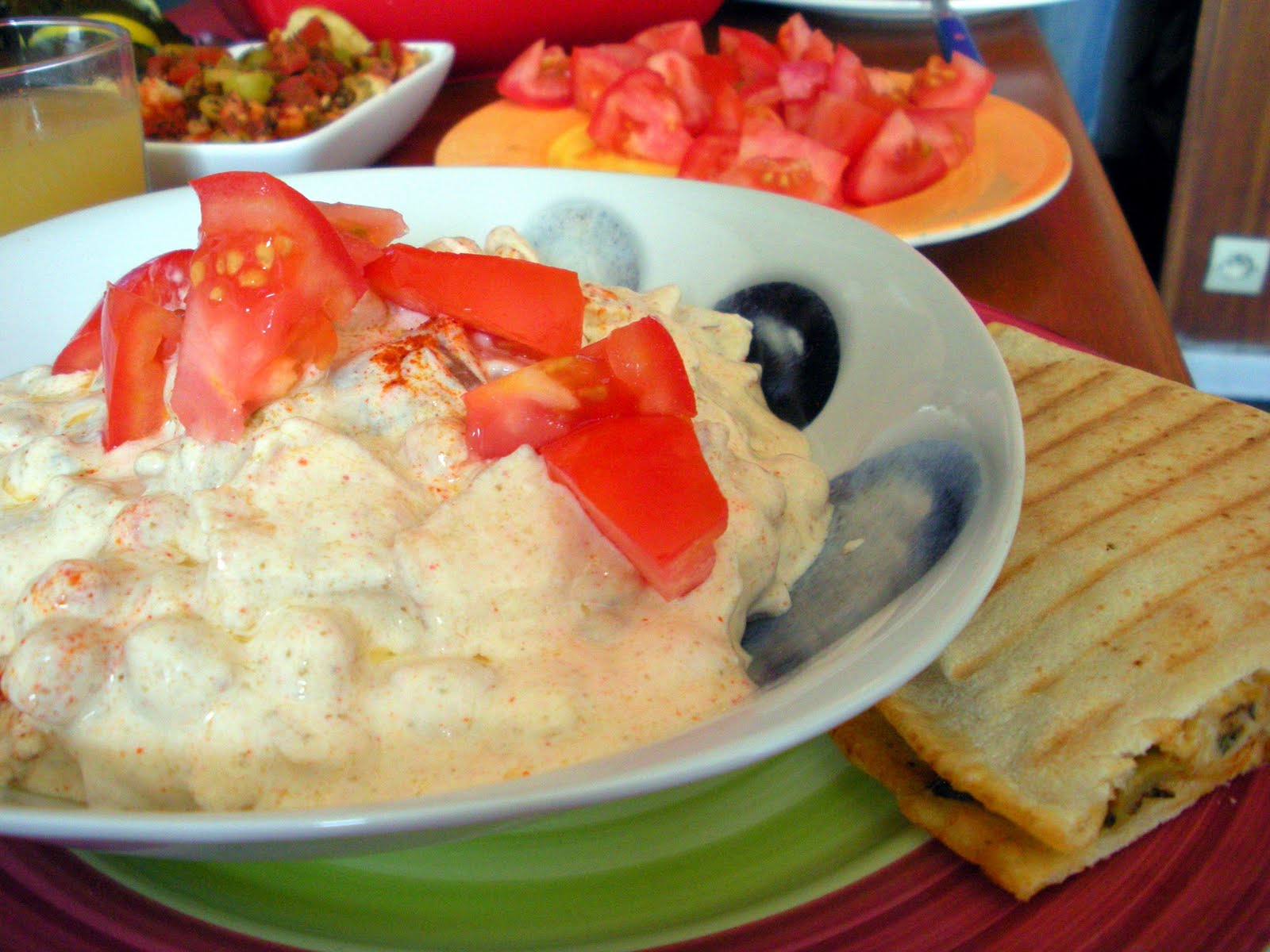
Encore un plat délicieux grâce à mon pote Safi. . .
Ce plat s’appelle Fatté de Damas (le verbe fatta en syrien –ou en arabe- veut dire couper avec la main (mais pas les papiers) ; le mot Foutat signifie les miettes du pain ou ce qui tombe pendant qu’on mange une baguette.
Fatté de Damas
Première étape
- 1 kilo de Yaourt turque
- Tout petit peu d’eau (la quantité d’une tasse de café) et on remue bien le yaourt avec de l’eau ajoutée.
- 2 grosses gousses d’ail écrasées ou 4 si petites et on remue l’ensemble
- Assez de sel
- 2 cuillères de Tahina et on remue encore
- Demi-citron, à remuer aussi avec l’ensemble
- Beaucoup de cumin : deux grande cuillères
- Du piment moulu
Ce mélange reste froid en attendant de finir les autres choses.
Deuxième étape
500 grammes de pois chiches cuites, à chauffer dans l’eau jusqu’au bouillonnement. Mettre les pois chiches (sans l’eau) dans un plat. Y ajouter du citron, du cumin et du piment moulu.
 Troisième étape :
Couper trois galettes de pain oriental en petits morceaux et les frire dans de l’huile végétale (comme les pommes de terre) jusqu’à ce que les morceaux deviennent craquants. Mettre le pain frit dans le même plat (sur les pois chiches).
Dernière étape
Verser la sauce (du yaourt) sur l’ensemble (les poids-chiches et le pain) et mélanger bien. On ajoute encore du cumin et du piment moulu. Le plat est servi avec des tomates coupées en tranches ou morceaux moyens, des feuilles de menthe fraiche ou autres sortes de légume.
Fatté de Damas
Première étape
- 1 kilo de Yaourt turque
- Tout petit peu d’eau (la quantité d’une tasse de café) et on remue bien le yaourt avec de l’eau ajoutée.
- 2 grosses gousses d’ail écrasées ou 4 si petites et on remue l’ensemble
- Assez de sel
- 2 cuillères de Tahina et on remue encore
- Demi-citron, à remuer aussi avec l’ensemble
- Beaucoup de cumin : deux grande cuillères
- Du piment moulu
Ce mélange reste froid en attendant de finir les autres choses.
Deuxième étape
500 grammes de pois chiches cuites, à chauffer dans l’eau jusqu’au bouillonnement. Mettre les pois chiches (sans l’eau) dans un plat. Y ajouter du citron, du cumin et du piment moulu.
 Troisième étape :
Couper trois galettes de pain oriental en petits morceaux et les frire dans de l’huile végétale (comme les pommes de terre) jusqu’à ce que les morceaux deviennent craquants. Mettre le pain frit dans le même plat (sur les pois chiches).
Dernière étape
Verser la sauce (du yaourt) sur l’ensemble (les poids-chiches et le pain) et mélanger bien. On ajoute encore du cumin et du piment moulu. Le plat est servi avec des tomates coupées en tranches ou morceaux moyens, des feuilles de menthe fraiche ou autres sortes de légume.
vendredi 25 juin 2010
Macaroni and Cheese

On a recent visit to France, my father and brother thoughtfully brought a third member of the family with them—a block of extra-sharp Wisconsin cheddar. The gift was greatly appreciated. Being Americans and Wisconsinites, you could say that melted cheddar runs in our blood.
French people, pretending they know everything anybody ever needs to know about cheese, snub their noses and purse their lips at this suspiciously colored, pleasantly odored, non-runny susbstance; “That’s not cheese.”
I tell them, “Hey—just because it’s orange doesn’t mean it’s not real cheese.” More cheddar and crackers for me—they can have their smelly camembert.
But you can trick a French person into liking cheddar by making it into a sauce. Specifically, in the supreme American specialty Mac N’ Cheese. That is, if you're willing to share your precious cheddar that was smuggled across customs from the US. It'd take more than one cheese fondue, in my opinion, to make up for that.
Baked Macaroni and Cheese
1 (8-ounce) package dried elbow macaroni or favorite pasta (about 2 1/4 cups, uncooked)
1/4 cup (4 tablespoons) butter
1/4 cup all-purpose flour
2 cups milk
1 tablespoon whole-grain Dijon mustard
1/4 to 1/2 teaspoon salt
1/2 teaspoon freshly ground pepper
1/4 teaspoon hot sauce
1 (8-ounce) package shredded sharp Cheddar cheese (about 2 cups)
Topping (optional):
1/2 cup fresh breadcrumbs
2 tablespoons butter, melted
1. Preheat oven to 350°.
2. Cook pasta, drain and set aside. Melt butter in a large heavy saucepan over low heat; add flour, stirring until smooth. Cook 3 to 5 minutes, stirring constantly. Turn heat to medium; gradually whisk in milk, and cook over medium heat, stirring or whisking constantly until thickened, about 10 minutes. Stir in pasta, mustard, and next 4 ingredients, stirring just until cheese begins to melt.
3. Pour pasta mixture into a lightly greased 13- x 9-inch baking dish. Sprinkle with more grated Cheddar. If desired, top with fresh breadcrumbs, and drizzle evenly with melted butter.
4. Bake, uncovered, at 350° for 25 minutes or until bubbly and golden. Let stand 5 minutes before serving.
mercredi 16 juin 2010
Soupe aux fèves, à la syrienne

L’autre soir j’ai eu le plaisir de gouter à quelques plats de la cuisine syrienne, grâce à Safi, un ami syrien. Le meilleur était une soupe aux fèves—pourtant je le dis avec de la difficulté, voit que tous les plats étaient excellents.
Les épices sont indispensables à la soupe et les salades, ainsi que le fromage syrien, qui est sec et très salé.
Prenez un verre d’Arak suite à votre repas ; c’est un alcool fort avec un gout d’anis qui ressemble au Pastis.
 Soupe aux fèves :
- Prendre une boîte de fèves…
- Avant de chauffer le contenu, écraser de l’ail (2-3 gousses) et les chauffer ensemble jusqu’au bouillonnement.
- Ajouter une bonne quantité de cumin (mélanger pour voir si la couleur du cumin domine)
- Ajouter de la harissa et du piment moulu (mélanger aussi)
- Un citron
- De la Tahina (pas indispensable et la quantité est au choix, moi je mets une grande cuillère)
- Juste avant de servir, verser plutot beaucoup d’huile d’olive sur la soupe
Les épices sont indispensables à la soupe et les salades, ainsi que le fromage syrien, qui est sec et très salé.
Prenez un verre d’Arak suite à votre repas ; c’est un alcool fort avec un gout d’anis qui ressemble au Pastis.
 Soupe aux fèves :
- Prendre une boîte de fèves…
- Avant de chauffer le contenu, écraser de l’ail (2-3 gousses) et les chauffer ensemble jusqu’au bouillonnement.
- Ajouter une bonne quantité de cumin (mélanger pour voir si la couleur du cumin domine)
- Ajouter de la harissa et du piment moulu (mélanger aussi)
- Un citron
- De la Tahina (pas indispensable et la quantité est au choix, moi je mets une grande cuillère)
- Juste avant de servir, verser plutot beaucoup d’huile d’olive sur la soupe
La salade qui l’accompagne :
- 2 tomates (à couper en très petits morceaux)
- Un oignon (à couper en très petits morceaux)
- Beaucoup de cumin sur l’ensemble (les tomates et l’oignon)
- Assez de sel
- Demi-citron
- de l’huile de l’olive
- Du concombre mariné (pas indispensable)
- 2 tomates (à couper en très petits morceaux)
- Un oignon (à couper en très petits morceaux)
- Beaucoup de cumin sur l’ensemble (les tomates et l’oignon)
- Assez de sel
- Demi-citron
- de l’huile de l’olive
- Du concombre mariné (pas indispensable)
Salade aux olives (servir avec du Hommos et des sandwiches de fromage)
- Demi-tomate coupée en très petite morceaux
- Des olives coupées en petite morceaux
- Du piment moulu sur l’ensemble
- Beaucoup de thym
- Assez de citron (moins qu'un demi-citron)
- Un peu d’huile d’olive
- Concombre mariné (pas indispensable)
- Demi-tomate coupée en très petite morceaux
- Des olives coupées en petite morceaux
- Du piment moulu sur l’ensemble
- Beaucoup de thym
- Assez de citron (moins qu'un demi-citron)
- Un peu d’huile d’olive
- Concombre mariné (pas indispensable)
vendredi 11 juin 2010
Pan Bagnat

Pan Bagnat is a speciality of Nice but is found in pretty much any boulangerie (bakery) in France. It’s a tuna sandwich with a vegetables based off of the classic salad Niçoise.
Hollow out a baguette or a round loaf. Fill one hollow with canned tuna packed in water or tomato sauce (as in the picture).
Add lettuce, thinly sliced red onions, thinly sliced green pepper, sliced hard-boiled eggs, tomatoes, cucumbers, and olives. You can add a few anchovies if you like them.
For the sauce, drizzle on balsamic vinegar and olive oil, with or without mustard.
If you added all the ingredients I mentioned, the sandwich will be stuffed to bursting. Squash it down hard or put it under a weight for a few minutes. Then proceed to transfer the stuffing from sandwich to belly.
Hollow out a baguette or a round loaf. Fill one hollow with canned tuna packed in water or tomato sauce (as in the picture).
Add lettuce, thinly sliced red onions, thinly sliced green pepper, sliced hard-boiled eggs, tomatoes, cucumbers, and olives. You can add a few anchovies if you like them.
For the sauce, drizzle on balsamic vinegar and olive oil, with or without mustard.
If you added all the ingredients I mentioned, the sandwich will be stuffed to bursting. Squash it down hard or put it under a weight for a few minutes. Then proceed to transfer the stuffing from sandwich to belly.
dimanche 6 juin 2010
Radishes with salt and butter

Summer in France means eating outside on the terrace, a bowl of pink and white radishes on the table, accompanied by a pat of butter and a sprinkle of salt.
Eat the radishes raw with your fingers, softening their bite with a bit of sweet butter and salt. Perfectly refreshing for a small snack--and so cute too!
Eat the radishes raw with your fingers, softening their bite with a bit of sweet butter and salt. Perfectly refreshing for a small snack--and so cute too!
samedi 5 juin 2010
Chartreuse
 Chartreuse is both a green-yellow font color and a French herbal liquor of the same hue. The liquor came first, first distilled in the early 17th century, and all of the world’s current supply originates from La Grande-Chartreuse, a monastery in the Chartreuse mountain range in the French Alps, about 20 km north of my house.
Chartreuse is the most famous product that comes from Grenoble itself, and we are proud and hardy Chartreuse drinkers, despite the 55% alcohol content and ‘particular’ plant taste. There are two kinds of Chartreuse, green and yellow, the yellow being less strong and much sweeter. Both kinds are made from a combination of plants (130 different plants for the green), and the recipes are TOP-SECRET. That’s not top-secret in the way that Coca-cola’s recipe is top-secret. Supposedly, only 2 monks at La Grande-Chartreuse know the recipe, and they collect and sort the plants themselves, transport the plants to the distillery in Voiron where the liquor is fabricated, and regulate the temperature and aging of the liquor held in the cellars. Meaning that the production of all the Chartreuse sold in over 100 countries the world over is entirely in the hands of two monks from Grenoble. If that doesn’t make for a special liquor, I don’t know what does.
Fascinated by this story of reclusive woodland monks and their zealously guarded secret brew, I had plenty of questions for the poor tour guide at the Chartreuse distillery. What is the difference between green and yellow Chartreuse? How long is it aged? Are all the plants from the region? How much money do the monks make?
Each time I got, “I don’t know, Madame. The recipe is unknown.” Perhaps a strategic marketing tactic on the part of the monks, as this made me even more fascinated by the shimmery green liquor and I ended up buying a bottle in the gift shop.
Even without the story behind it, Chartreuse is a delicious liquor. It’s a beautiful color, is quite strong, and the taste is distinctive and fresh. It’s best served on its own, so chilled that it smokes, over a single ice cube.
But if you have a taste for a cocktail, try one of these:
Green Chaud
This is a popular alternative to hot chocolate on the slopes in the Alps. Add a shot of Green Chartreuse to your hot chocolate.
Orangina Chartreuse
1 part Green Chartreuse
1 part vodka
3 parts Orangina
Shake the glass a bit before serving to create foam.
Chartreuse Tonic
1 part Green Chartreuse
4 parts tonic water
lemon slice garnish
lundi 24 mai 2010
Moules Frites

Ask most Americans what French cuisine is and you’ll probably get the following responses:
Croissants
Cheese, wine, and bread
Fondue
Frog legs
Escargot
Saucey dishes in expensive restaurants
Apart from going to France, all we can know about French cuisine what is exported to the US, and unfortunately most of the cuisine exported from France to the rest of the world is gastronomic cuisine that is, like in the US, confined to restaurants where you have to have a reservation (i.e. restaurants that I don’t go to). The homey French cooking, the food of the working classes, the recipes that are passed down from grandmother to mother, the cheap and easy recipes—are sadly skipped over.
Moules frites, or “mussels and fries” is one of those dishes. It’s a rather working class meal (think sloppy joes), and eaten happily by French kiddies at school cafeterias. The mussels come in a bowl of sauce of your preference, the classic one being Moules marinières, which doesn’t mean marinara sauce but refers to sailors. Apparently French sailors ate mussels with a white wine, garlic, and shallot sauce. Classy. Fries are the mussels’ steadfast companion, served on the side.
Moules frites is a sans-silverware eating experience, a tremendous advantage. Use the empty shells like pincers to pick out the mussels and spoon up the broth-like sauce. Don’t neglect the sauce by all means—dip your fries in, sop it up with bread, eat it like soup, whatever, but don’t send it back with your dirty napkin floating on top, please.
Moules Marinières
3 pounds of fresh mussels, scrubbed as well as you can and beards removed
1/2 bottle of dry white wine
3-4 shallots, finely minced
2 cloves of garlic, pressed
1/2 cup parsley
1. Put the wine, garlic and shallots in a deep pot and bring to a boil. Let boil for a couple of minutes to cook the shallots and garlic and then add thoroughly washed mussels. Discard any open or broken mussels, as this means they are already dead.
2. Cover the pot tightly and cook for about ten or fifteen minutes. When the mussels open cut the heat but leave the lid on the pot for a few minutes more.
3. Put the mussels in serving bowls. Pour on the sauce and add a handful of parsley. Serve with bread and fresh homemade fries.
Croissants
Cheese, wine, and bread
Fondue
Frog legs
Escargot
Saucey dishes in expensive restaurants
Apart from going to France, all we can know about French cuisine what is exported to the US, and unfortunately most of the cuisine exported from France to the rest of the world is gastronomic cuisine that is, like in the US, confined to restaurants where you have to have a reservation (i.e. restaurants that I don’t go to). The homey French cooking, the food of the working classes, the recipes that are passed down from grandmother to mother, the cheap and easy recipes—are sadly skipped over.
Moules frites, or “mussels and fries” is one of those dishes. It’s a rather working class meal (think sloppy joes), and eaten happily by French kiddies at school cafeterias. The mussels come in a bowl of sauce of your preference, the classic one being Moules marinières, which doesn’t mean marinara sauce but refers to sailors. Apparently French sailors ate mussels with a white wine, garlic, and shallot sauce. Classy. Fries are the mussels’ steadfast companion, served on the side.
Moules frites is a sans-silverware eating experience, a tremendous advantage. Use the empty shells like pincers to pick out the mussels and spoon up the broth-like sauce. Don’t neglect the sauce by all means—dip your fries in, sop it up with bread, eat it like soup, whatever, but don’t send it back with your dirty napkin floating on top, please.
Moules Marinières
3 pounds of fresh mussels, scrubbed as well as you can and beards removed
1/2 bottle of dry white wine
3-4 shallots, finely minced
2 cloves of garlic, pressed
1/2 cup parsley
1. Put the wine, garlic and shallots in a deep pot and bring to a boil. Let boil for a couple of minutes to cook the shallots and garlic and then add thoroughly washed mussels. Discard any open or broken mussels, as this means they are already dead.
2. Cover the pot tightly and cook for about ten or fifteen minutes. When the mussels open cut the heat but leave the lid on the pot for a few minutes more.
3. Put the mussels in serving bowls. Pour on the sauce and add a handful of parsley. Serve with bread and fresh homemade fries.
samedi 22 mai 2010
Crêpes vs. Pancakes
 A crepe, as you are probably familiar with, is a very thin pancake originally from Brittany, a Northern region of France, and now widespread throughout France and popular in much of the world. Crepe batter is essentially identical to pancake batter, except that crepe batter contains more milk, making it thinner, and no leavening agent.
In France crepes are not eaten exclusively (or even very often) for breakfast, like pancakes are in the United States; instead, savory crepes called galettes are eaten as a meal and sweet crepes (crêpes sucrées) are eaten as dessert.
The batter preparation between galettes and dessert crepes differs slightly. Galettes are made with buckwheat flour, rendering the batter brown, and no sugar is added.
My favorite savory fillings for galettes:
Tomatoes, goat cheese, and pepper
Sliced salmon and chives
Sautéed mushrooms, asparagus, and gruyere cheese
An egg, sunny-side-up
Dessert crepes add a couple of tablespoons of sugar to the batter and use regular wheat flour.
Sweet crepe fillings:
Any sliced fruit or jam
Nutella
Chestnut cream
Peanut butter
Sliced bananas caramelized in brown sugar and rum
Granulated sugar and lemon juice
Butter and honey
I still prefer a thick stack of pancakes to crepes; the soft chewy texture of pancakes is hard to beat. But it’s true that crepes are more portable, accounting for the afflux of crepe stands in France (and absence, sadly, of pancake stands in the United States). And they are more attractive, maybe, folded elegantly with just the colored edges of sweet fillings tumbling out, powdered sugar sprinkled over top. And they are certainly more exotic and impressive, should you decide to make a romantic end to a dinner end (pancakes might fail to showcase your culinary skills—crepes are no harder to make, but no one has to be the wiser). And—you can make a respectable meal out of savory crepes, while eating pancakes for dinner is probably popular only in frat boy circles.
Tips for making crepes:
Making crepe batter beforehand and refrigerating it for 30 minutes to an hour helps produce exceptionally tender crêpes because as the batter chills, the flour expands and absorbs the liquid. When cooking the crepes, pour a ladle of batter into a non-stick flat-bottomed skillet and tilt the pan so that the batter spreads out evenly and thinly. You can add a bit of butter to the skillet to avoid sticking. The thinner the crepe, the better. Cook 1-2 minutes on the first side, until the edges begin to curl, and flip and cook another minute. Crepes cool very quickly, so if cooking for guests you can cook the crêpes in advance, then fill and broil them just before serving. Sprinkle dessert crepes with powdered sugar.
 Black Pepper Crêpes with Goat Cheese and Tomatoes
Serves 4
1 cup milk
1 egg
1/2 cup plus 1 Tbs. all-purpose flour
1/2 tsp. canola oil
1 tsp. freshly ground pepper, plus more, to taste
1/2 tsp. salt, plus more, to taste
8 tsp. unsalted butter
4 plum tomatoes, thinly sliced
4-oz. log of goat cheese (chèvre), crumbled
In a large bowl, combine the milk, egg, flour, oil, the 1 tsp. pepper and the 1⁄2 tsp. salt and mix until smooth. Refrigerate for 1 hour.
In a crêpe pan over medium heat, melt 1 tsp. of the butter to coat the pan evenly. Lift the pan at a slight angle and pour 2 Tbs. of the batter into the center, tilting the pan to spread the batter to the edges. Return the pan to the heat and cook until the crêpe is golden underneath, 1 to 2 minutes. Flip the crêpe over and cook for 1 to 2 minutes. Transfer to a plate and cover. Repeat to make 8 crêpes.
Position a rack 6 inches from the broiler and preheat. Line a baking sheet with parchment paper.
On a clean work surface, lay a crêpe flat. Put one-eighth of the tomato slices on the crêpe and top with one-eighth of the cheese. Season with salt and pepper. Fold the crêpe into quarters and transfer to the prepared baking sheet. Repeat with the remaining crêpes and filling. Broil until the crêpes are golden brown, 3 to 5 minutes.
Sweet crepes
Makes about 20 crepes
1 1/3 cups whole milk, room temperature
1 cup all purpose flour
3 large eggs
3 tablespoons unsalted butter, melted
1 tablespoon sugar
1/4 teaspoon salt
Nonstick vegetable oil spray
1. Mix first 6 ingredients in blender just until smooth. Cover batter and chill at least 15 minutes and up to 1 day.
2. Spray 7-inch-diameter nonstick skillet with vegetable oil spray and heat over medium heat. Pour 2 tablespoons batter into pan and swirl to coat bottom. Cook until edge of crepe is light brown, about 1 minute. Loosen edges gently with spatula. Carefully turn crepe over. Cook until bottom begins to brown in spots, about 30 seconds. Transfer to plate. Cover with paper towel. Repeat with remaining batter, spraying pan with oil spray as needed and covering each crepe with paper towel. (Can be made 1 day ahead. Cover and chill.)
3. Fill as desired and sprinkle with powdered sugar.
mercredi 12 mai 2010
White Asparagus

White asparagus is a highly prized item in France. It’s more tender than green asparagus, with a bit less flavor, and it’s more expensive too. But it makes your pee smell just as much as green asparagus.
Personally, I prefer to cook with green asparagus because I find the flavor stronger therefore and more agreeable, as I really like asparagus. White asparagus is quite nice, however, cold with just a bit of dressing as a simple salad.
White asparagus is found commonly in jars here in France, which is perfectly acceptable. When cooking raw stalks it is necessary to peel the outer skin and trim the tough ends. The tips cook faster than the ends, so tie the stalks in a bunch with string and cook them standing up in boiling water, the tips poking out of the water, until tender.
Why the white color? Actually, white asparagus is made white by covering the plant with soil to block the production of chlorophyll.
White asparagus goes particularly well with citrus flavors in a salad, like the one below.
Personally, I prefer to cook with green asparagus because I find the flavor stronger therefore and more agreeable, as I really like asparagus. White asparagus is quite nice, however, cold with just a bit of dressing as a simple salad.
White asparagus is found commonly in jars here in France, which is perfectly acceptable. When cooking raw stalks it is necessary to peel the outer skin and trim the tough ends. The tips cook faster than the ends, so tie the stalks in a bunch with string and cook them standing up in boiling water, the tips poking out of the water, until tender.
Why the white color? Actually, white asparagus is made white by covering the plant with soil to block the production of chlorophyll.
White asparagus goes particularly well with citrus flavors in a salad, like the one below.
White Asparagus, Orange and Arugula Salad
Ingredients:
SALAD:
•2 bunches of white asparagus, trimmed
•2 oranges, peeled
•1 1/2 cups of arugula (roquette)
•1/2 Spanish onion, sliced into thin rings
DRESSING:
•60 ml good quality, extra virgin olive oil
•30 ml red wine vinegar
•1 small garlic clove, finely chopped
•A pinch of sea salt
•Freshly ground black pepper
Preparation:
1.Use a sharp knife to slice the pith off the oranges and discard. Slice the oranges into segments and place in a mixing bowl. Set aside.
2.Blanch the asparagus (1 to 2 minutes), then refresh in a bowl of cold water, drain and halve length-ways.
3.Add asparagus to orange segments along with the onion rings and arugula.
4.Whisk red wine vinegar, extra-virgin olive oil, salt and pepper in a small bowl to combine, toss through salad. Serve immediately.
Inscription à :
Articles (Atom)